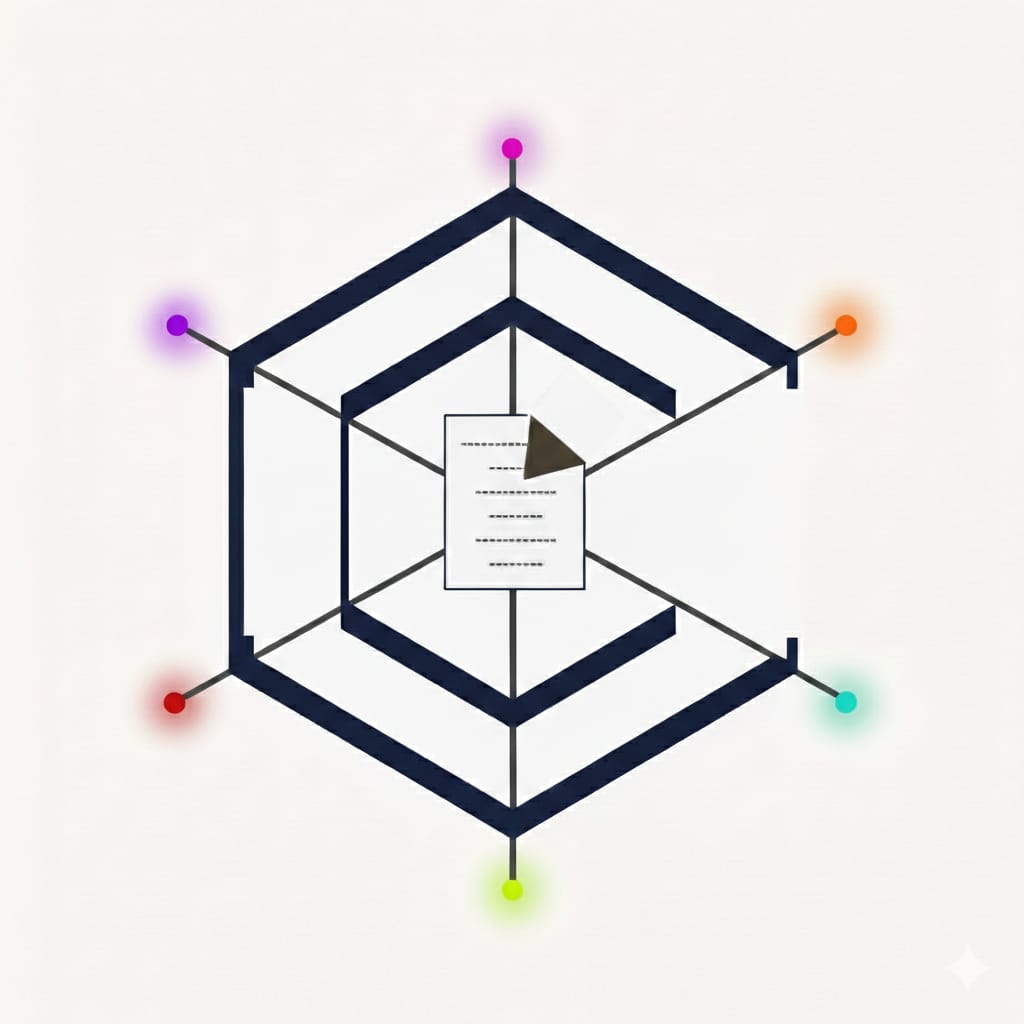
The six studios
One subscription includes every studio. No feature is locked behind a module. Each studio hands its work to the others: a case written in AuthorLab becomes a film in StoryLab, a simulation in SimulationLab, a session in EducatorLab, a Preparation Room for learners and a document in ResearchLab's corpus — with the same characters, faces and voices throughout.
AuthorLab — write the case
A case-method authoring studio with two surfaces, the case and the teaching note, built from typed sections (hook, protagonist, organisation, context, narrative, exhibit, quote, timeline, decision, results, and source-document sections).
- Eight templates, each with a tailored setup wizard: Classic MBA Case, Customer Story, Simulation-First Scenario, HR / Conflict Scenario, Startup / Idea Stress-Test, Legal Training Matter, Job & Interview Prep, Blank Page. The wizard asks the questions that matter for that template, takes PDF or pasted uploads where appropriate, and lands the author on a part-filled document. HR and Legal deliberately take no uploads, to keep real people's details out of the room.
- Job & Interview Prep is a complete personal use-case: the job description, your CV, your supporting statement, the real panel by name, the questions you have been told to expect, and the question you dread — which then becomes a rehearsable interview simulation.
- The Writers' Room: five AI co-authors, including a stage-aware Case Coach that knows whether you are at a blank page, planning, drafting or finishing, and a Case Reviewer for critique of a finished draft. A section you have not written yet is never mistaken for your prose.
- One-click hand-off to SimulationLab (arriving with the right format pre-selected), StoryLab, EducatorLab or ResearchLab; PDF text extraction; word targets; server-side saving to a personal library.
StoryLab — the CaseStory film
Generates a narrated, animated audio-visual telling of the case from its text: scenes, settings, a cast with faces, per-character voices, procedural sound design, cinematography passes and selectable visual themes.
- A multi-agent pipeline (segmenter, director, renderer) builds the scenes; the player speaks each line in the right character's voice and lip-syncs to the audio.
- Full tellings or short cuts; scene ranges embeddable separately so an educator can interleave discussion.
- Publish and embed by link or iframe; a per-user library; the theme can be switched after generation; narration can be pre-rendered so public replays cost nothing. Photos embedded in a case PDF are extracted and used.
SimulationLab — twelve simulation formats
An AI Architect designs a simulation from the case (characters, stages, metrics, scenario); an AI Director plays every character turn by turn; an AI Examiner writes the debrief. Design-time grounding reads up to 40,000 characters of the case plus a distilled fact sheet. The twelve formats are listed below.
- Characters with faces derived from their names, so the same person looks the same in the film, every simulation and the Preparation Room. Characters speak, with on-screen text and transcripts.
- Answer out loud in The Interview and Video Call: browser speech recognition, auto-send on a pause, hands-free mode; the microphone is never open while a character is speaking.
- Scoring and debrief: per-turn scoring against named metrics; a written Examiner debrief with a hard time guarantee; a wrong answer is never marked right.
- Design brief controls: player role, tone, difficulty, length, learning objectives, and for interviews, the questions the panel has committed to ask.
- An embeddable player used by EducatorLab sessions, the Case Experience, LTI launches and the public demo.
EducatorLab — compose and run the session
A session is a composable sequence of sections: PDF, text, poll, survey, AI persona, Word or Excel document, SmashCase quiz, CaseStory scene range, video, simulation. Sections are revealed live by a facilitator, played solo, or compiled into one experience.
- Two delivery modes: a live session class at a date and time, or a solo course pack learners work through in their own time with an optional close date.
- Live sessions with learner presence, polls, SmashCase (a quick-fire round, up to ten questions), AI personas extracted from the case that learners can question, session logs and history.
- Case Experience: compile the session into one continuous arc — film, brief, simulation, debrief — with story framing, carry-forward between simulations and outros.
- Preparation Room publishing: one button builds a pre-session room from the session (the film, the written case, the people with faces, a knowledge check written from the case, and "Start the session"), publishes it as one link, and puts a button on every enrolled learner's LearningLab card. The educator sees what is in the room, and what was left out and why, before publishing.
- The case can be uploaded as a PDF or picked from the author's library; sessions keep their case text and are saved server-side; invite codes carry the pre-reading and the room.
LearningLab — the learner's home
- Enrol with an invite code; upcoming and past sessions; join the live class or start the course pack.
- Protected pre-reading viewer: the case is rendered to canvas, never served as a file, with a per-reader watermark on every page and copy, print, save and screenshot interception.
- A Preparation Room button per enrolled session; certificates; leaderboard; mastery tracking.
ResearchLab — across a corpus of cases
Upload many case PDFs and analyse them together: theme maps, entity graphs, a similarity matrix, sentiment, patterns and anomalies; corpus statistics; a four-agent research team (Principal Investigator, Associate, Cross-Examiner, Adjudicator) that answers questions across the corpus; pre-built research actions; a report builder with PDF export; saved research.
The twelve simulation formats
Every format is generated from the written case, not from a hand-authored script, so the same case can be played in several of them. Each ends in the Examiner's debrief.
| Format | What the learner does |
|---|---|
| The Interview | Sits before a panel of two to four named interviewers who each want something different. One question at a time; the panel's manner follows the chosen tone; each panellist's impression moves separately; a verdict at the end. Supports a list of questions the panel has committed to ask, in order. |
| Video Call | A one-to-one or small-group call with a character who speaks aloud; every answer scored. |
| Boardroom | Chairs a multi-party meeting where every member speaks their mind, aloud, and must be driven to a defensible decision. |
| Stakeholder Map | Works a map of parties with influence and stance; one move on one party ripples to allies and rivals, computed deterministically and explained in the debrief. |
| The Investigation | Finds out rather than decides: pulls exhibits (some locked until something leads to them, some red herrings), questions witnesses who know different things and may shade them, keeps a notebook, then states what happened, who, when and why and cites the evidence. Judged on whether the conclusion matches a hidden ground truth and whether the cited evidence proves it. |
| The Rollout | Leads a change to adoption over a clock: groups with weight, adoption, readiness and a concern; named people whose stance sways them; events along the way. Each period a small budget of effort goes on communicate, listen, train, pilot, quick win, incentivise, mandate or back a champion — each with different effects and side effects. Adopted, partial or stalled against target at the horizon. |
| Crisis Inbox | Triages emails, calls and alerts under a running clock. What is ignored escalates. |
| Courtroom Hearing | Examines and cross-examines witnesses drawn from the case before a judge, with objections and a judgment. |
| Branching Decisions | A decision tree with compounding consequences and world-state gauges. |
| Dashboard | Runs the operation period by period: KPIs against levers. |
| The Model | A deterministic financial model of the case, built on a proven template engine: the learner steers the numbers across periods and is graded on finance-literate metrics. Every number is computed, never guessed. |
| Role-play Chat | Steps into the case and talks it through with a character — negotiation, advice, persuasion. |
Preparation, experiences and cases
The Preparation Room
Everything a learner does before a session, as one link: the introduction, the CaseStory film, the written case, the people (with the faces they will meet), the Exhibit Room where it exists, and a knowledge check. Each piece reports progress back to the room, and completion opens "Start the session". Rooms are published from EducatorLab sessions; the knowledge check is written from the case itself, and for interview preparation it tests the candidate's knowledge of the role, the employer, the criteria, the panel and their own CV — written on their side, never as a judgement of them.
Case Experiences
A session compiled into one continuous arc that a learner plays end to end: film, decision, simulation, debrief, with framing between acts and consequences carried from one simulation to the next.
Starter cases
Ready-to-teach, free-to-use worked cases, including Averholt Medical: a 38-scene full-telling film, a written case with six exhibits, cast cards, an interactive Exhibit Room, a knowledge check, a trailer and a three-simulation case experience with debrief. Copy-on-open, so every user gets an editable copy. A playable demo runs with no sign-up.
MyLibrary and MyData
Everything a user makes, across studios, in one place with deep links. MyData is a GDPR subject-access and erasure panel: see your data, download a copy, delete your account.
Accessibility
Light and dark themes everywhere, including for learners in a live session; text alongside all audio, with transcripts; mostly self-paced, turn-based interaction; responsive, zoomable layouts. Working towards WCAG 2.1 AA; not yet independently audited — the accessibility statement lists the known limitations plainly.
Identity, LMS, security and commercial terms
| Area | Status |
|---|---|
| Single sign-on | Live. SAML and OIDC federation; organisations mapped by email domain; roles applied on sign-in. |
| LTI 1.3 launch | Live and proven. A learner clicks an assignment in Canvas, Moodle, Blackboard, Brightspace or any LTI 1.3 platform and lands in the simulation, already signed in. |
| LTI grade passback | In development. Built; not yet proven against a live LMS, so not advertised as a feature. |
| LTI deep linking | Planned. |
| SCORM / xAPI | Not offered. LTI 1.3 is the LMS route. |
| Hosting and residency | Hosted in the United Kingdom. Encrypted in transit and at rest. |
| AI processing | Established AI providers act as processors under data-processing terms; your content is not used to train their general models. Where processing takes place outside the UK it relies on the safeguards recognised under UK data-protection law. |
| Payments | Handled by a PCI-compliant payment provider; card details never touch CaseConduit. |
| Data processing agreement | A standard DPA is included at every paid tier, on request. |
| Certifications | None held by CaseConduit itself yet; stated plainly on the trust page. |
| Content protection | Canvas-rendered case text, personalised watermarking and interaction blocks in the learner pre-reading and live-session case views. |
| Case rights | Tools, not a publisher: users bring their own cases or use the free starter cases. CaseConduit complements case publishers and never replaces them. |
Pricing
Public and self-serve, with no sales calls. Full detail on the pricing page.
- Explorer — free forever: 150 credits a month, all six studios, the starter cases, 5 learner-seats a month, MyLibrary, personal use with watermarked embeds.
- Starter — £12 a month: 500 credits, 25 learner-seats a month, unlimited saved work.
- Pro — £39 a month: 2,000 credits, 100 learner-seats a month, commercial embed and publishing rights, priority generation.
- Team — £149 a month: 8,000 pooled credits, up to 5 author seats, 500 learner-seats a month pooled, shared library, admin controls.
- Enterprise — from £1,499 a month: multi-entity rollouts, bespoke contract and DPA terms, volume seat bundles.
- Delivery is per learner on top of the plan: £1.50 per learner at the education rate, £3 at the corporate rate. Creating is covered by credits; a film or a simulation costs credits once and plays as many times as the seats allow.
What CaseConduit does not do yet
Stated plainly, so a comparison can be made on facts.
- No SCORM or xAPI export. LTI 1.3 is the LMS route.
- LTI grade passback is built but unproven against a live LMS; deep linking is not built.
- The Exhibit Room and the trailer are hand-built per case; they are not yet generated automatically from a session the way the film, case, people and knowledge check are.
- Learner progress in a published Preparation Room stays in the learner's browser; it is not yet reported back to the educator.
- No independent accessibility audit and no security certification (ISO 27001, Cyber Essentials, SOC 2) held yet.
- No native mobile app for the platform.
- No marketplace of third-party published cases. You bring your own or use the free starter cases.
- No live video or webcam between participants; live sessions are facilitator-revealed sections, polls and AI characters, not a video classroom.
- Witnesses in The Investigation and reactions in The Rollout are text in this release; the other conversational formats speak.
How it differs in kind from a single-simulation product
Most case-study platforms offer one lane: a fixed role-play simulation played against a script and graded at the end. CaseConduit's differences are structural rather than feature-by-feature.
- A suite, not a simulation. Authoring, a film, twelve simulation formats, a classroom composer, a learner home with protected reading, and a research workbench share one case, one cast, one set of faces and voices.
- The case is the source of truth. Every simulation, persona, quiz and film is generated from and grounded in the written case, not from a hand-authored script per scenario.
- Composable delivery. The same case can be taught live and facilitated, played solo as one continuous experience, run as a game in the room, or rehearsed privately — and packaged with a Preparation Room before the session.
- Honest assessment. Scores are per turn against named metrics; the debrief is written and time-bounded; interviews track each panellist's impression separately; investigations are judged on evidence actually cited; rollouts are computed, not narrated into existence.
- Both lanes, and a personal one. Education pricing and LTI alongside corporate SSO, HR and legal templates and corporate seat pricing — and a personal lane, job and interview preparation, that no classroom product covers.
- Self-serve and transparent. Public pricing, a free tier that includes everything, no sales calls, and a trust page that lists what is not certified as readily as what is.